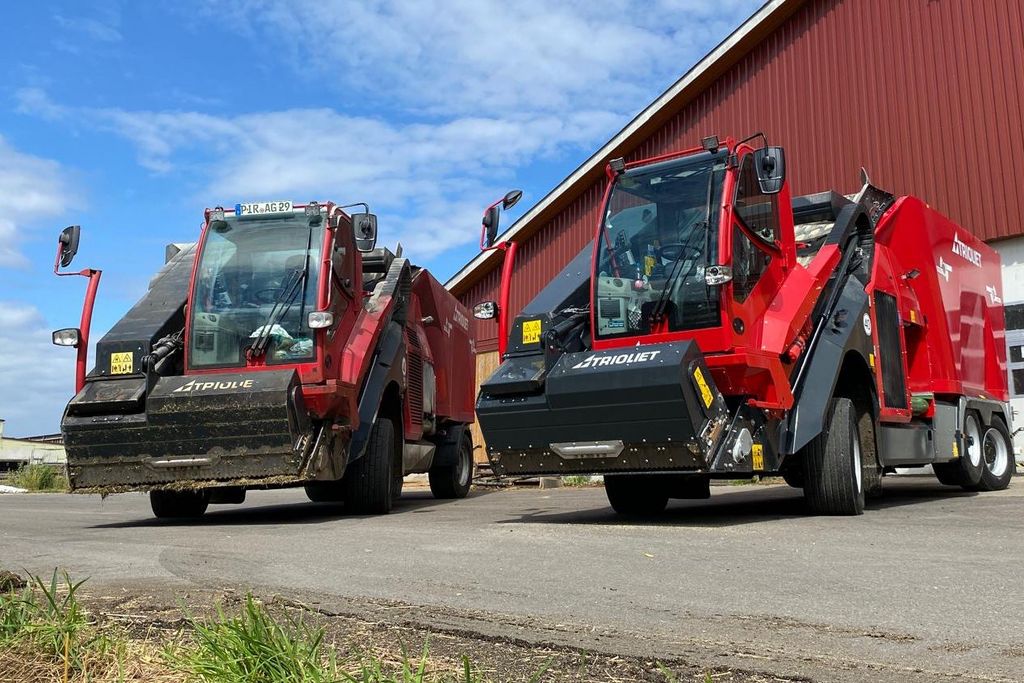


Niederseidewitz was the very first customer for the first-generation Triotrac.The twenty-cubic-metre self-propelled feed mixer was put into service at this dairy farm with 980 dairy cows and 900 young cattle in 2008, and the Triotrac worked perfectly ever since. When it was replaced in 2018, in came a Triotrac L2 2000 VL. With the herd having grown to 1,200 dairy cows and 1,000 young cattle, the second Triotrac ran for more than 20,000 hours over six-and-a-half years, once again to the full satisfaction of Triotrac driver Lutz Freudenberg.
Eight different rations are prepared every day for a total of twenty loads, with the Triotrac working ten hours at a time.
After more than sixteen years, Triotrac was once again chosen as the farm's new mixer-feeder, this time with a capacity of twenty-four cubic metres and a lifting axle. According to owner Dr Fleischer and driver Lutz Freudenberg, who worked with the Triotrac models for practically every one of the 41,000 hours clocked up so far, the choice was an obvious one.
It allows us to process a large amount of feed very rapidly, saving an enormous amount of time
As Dr Fleischer states: "The machine has been working well for years. The new Triotrac can extract silage from walls of up to six metres in height. As our silage is five-and-a-half metres high, this was an important reason to go for another Triotrac. In addition, it allows us to process a large amount of feed very rapidly, saving an enormous amount of time. Up to 2008, we used a self-propelled fourteen-cubic-metre diet feeder from another manufacturer, with twelve feed turns taking at least seven hours a day. With the Triotrac, we only need five. That means we save fourteen hours of work a week, plus four litres of diesel an hour, as the Triotrac uses a cutting system instead of a mill. So, I need less fuel even though the machine is larger."
TRIOTRAC self-propelled feed mixer